







Abstract
This white paper presents the development of a sovereign UAE sounding‑rocket program powered by advanced hybrid rocket motor (HRM) technology, starting by employing a Nitrous Oxide (N₂O) and High‑Density Polyethylene (HDPE) propulsion system, leveraging its inherent safety, simplicity, and cost advantages. This approach bridges the gap between complex liquid propulsion and hazardous solid motors.
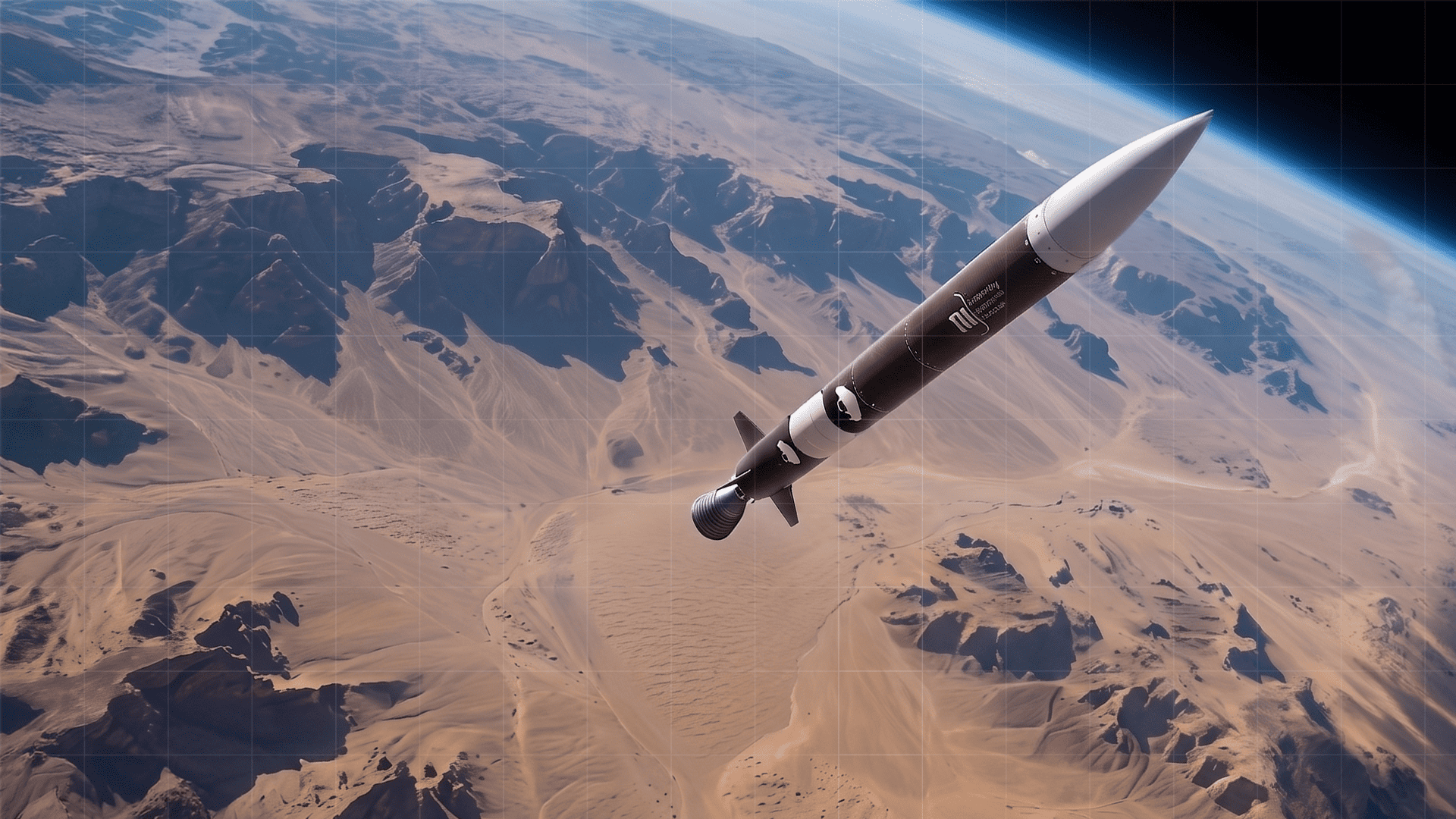
The program marks a national milestone: the first hybrid rocket fully designed, manufactured, tested, and flown within the UAE, achieving an apogee of 3.3 km and recovering safely via parachute. This accomplishment demonstrates TII’s full end‑to‑end capability to develop aerospace systems using local manufacturing and national talent.
Looking ahead, the roadmap includes the development of next‑generation hybrid rocket motors using paraffin and liquid oxygen (LOx), enabling significantly higher regression rates and consequently higher thrust. This propellant combination supports larger vehicles and more ambitious mission profiles. The broader vision includes establishing domestic launch infrastructure and maturing sovereign propulsion technologies that will ultimately support independent space access.
1. The Challenge
The suborbital propulsion landscape presents a strategic and technical challenge defined by safety, complexity, and external dependency:
- Limitations of Solid Motors: Solid propellant motors are classed as explosives, creating handling risks, limited controllability, and no throttle or restart capability.
- Complexity of Liquid Engines: Liquid propulsion systems offer high performance but require complex tanks, cooling, precision valves, and costly operations.
- Strategic Vulnerability: Reliance on imported propulsion systems restricts national autonomy in both space and defense.
- Infrastructure Gap: Limited access to local test stands and launch facilities hinders rapid iteration and system validation.
2. Solution: Hybrid Rocket Technology
This project proposes a Hybrid Rocket Motor (HRM) as the optimal solution, combining the simplicity of solid fuel with a development cost lower than liquids and a significantly high level of safety.
The engine utilizes Nitrous Oxide (N₂O) as a self-pressurizing oxidizer and High-Density Polyethylene (HDPE) as a stable, polymeric fuel. This combination yields a high specific impulse (comparable to non-cryogenic liquid propellants) while remaining cost-effective, storable and “green”.
Although the rocket propulsion community has been actively researching into hybrid rocket systems for several decades, and the concept itself dates back to the 1930s, it is still beneficial to remark the advantages offered by this propulsion system.
Hybrid rocket propulsion presents a compelling alternative to traditional solid and liquid propulsion systems, yielding a unique balance of safety, simplicity, and performance. These characteristics make HRMs particularly well-suited for specific applications, especially within the rapidly expanding small- to medium-lift launch vehicle market.
Key Advantages:
- Safety & Storability: The propellants are non-toxic, non-explosive, and can be stored indefinitely without specialized cryogenic equipment, making the operations and handling both on the ground and on the launch pad much easier.
- Cost-Efficiency: The use of common polymers and self-pressurizing oxidizers eliminates the need for exotic expensive fuels and complex feed systems, reducing overall mission costs.
The solid fuel grain in a HRM is typically inert and stable under thermal or mechanical stress, while the oxidizer, stored in a separate tank, is introduced into the combustion chamber only at ignition. This separation minimizes the risk of accidental detonation and significantly simplifies processes across the mission lifecycle, including manufacturing, storage, transportation, and launch operations.
When the mission allows using self-pressurizing oxidizers, like N₂O, the need for additional pressurization systems (e.g., pressurizing tanks and regulators) is eliminated, further simplifying design and operations.
HRMs are particularly well-suited for safe and flexible launch pad operations. In the event of a launch abort, the system poses minimal explosion risk. This is due to the non-reactive nature of the fuel and the ease of depressurizing the oxidizer tank (via venting), as well as the ability to deactivate ignition systems. This way, a failed ignition does not result in catastrophic failure or detonation.
Hybrid Rocket Motors provide an optimal balance of safety, simplicity, and performance by combining an inert solid fuel with a storable oxidizer. This architecture inherently reduces operational risk while offering good performance and scalability.
Propulsion Architecture:
- Oxidizer: Nitrous Oxide (N₂O), self‑pressurizing and non‑cryogenic
- Fuel: High‑Density Polyethylene (HDPE), stable and widely available
Key Advantages:
- Safety & Storability
- Cost Efficiency
- Operational Simplicity
Future versions will incorporate paraffin fuel with LOx, enabling higher regression rates, increased thrust, and improved performance for higher‑altitude missions.
3. Testing and Validation
Following completion of the design phase, the program advanced into a multi-stage testing and validation framework. This phase was structured around a rigorous, iterative methodology combining high‑fidelity numerical simulations with successive experimental test campaigns.
Two primary technical objectives guided this effort:
- Infrastructure Development: Establishment of dedicated rocket test stands and launchpad platform within the UAE, enabling the centralization of research, development, and testing activities.
- Engine Benchmarking: Development of a scalable propulsion system capable of delivering thrust levels ranging from 500 N to 5 kN.
At the core of this phase were extensive static hot‑fire tests, conducted both on standalone propulsion test rigs and with the rocket fully integrated onto the launch pad. These tests were designed to validate propulsion system performance, structural integrity, and operational reliability under realistic load conditions.
A key pillar of the project is the supply chain where the manufacturing phase involved an intensive, collaborative learning process between TII and local industrial partners. Early challenges revolved around the ability of domestic suppliers to meet the tight tolerances and quality standards required for aerospace‑grade prototype components. Through successive technical iterations and close engineering support, manufacturing processes were incrementally refined until the required precision and quality levels were consistently achieved. This collaboration extended into advanced materials development, enabling the indigenous production of high‑strength carbon‑fiber structural components.
System integration was treated as a standalone primary workstream, reflecting the inherent complexity of integrating flight‑critical hardware. Recognizing that simulations alone cannot capture all hardware interactions, each subsystem, including propulsion valves, recovery mechanisms, control architectures, and telemetry chains, underwent continuous testing, troubleshooting, and verification across multiple integration cycles.
Execution of these phases was led by a multidisciplinary team of 15 engineers specializing in propulsion, aerospace, mechanical, electrical, and software disciplines. Notably, a significant proportion of the team consisted of UAE nationals who assumed leadership roles in the development of critical capabilities, including flight control software, sensor integration, and launchpad operations. This integrated approach ensured that data acquisition, command and control, and telemetry systems were fully synchronized and flight‑ready, marking a successful transition from localized manufacturing to operational deployment.
4. First Flight
The inaugural flight encompassed the complete end‑to‑end design, fabrication, and launch of a hybrid‑powered sounding rocket. The mission successfully achieved the following objectives:
- Verified stable combustion of the N₂O/HDPE hybrid propulsion system
- Validated the vehicle’s structural and aerodynamic design under flight conditions
- Demonstrated reliable avionics performance and parachute‑based recovery
- Reached an apogee of 3.3 km
This mission represented the first fully indigenous hybrid‑rocket launch conducted in the UAE, marking a critical milestone in the development of national launch and propulsion capabilities.
5. Implementation and Scaling Up
Building on the success of the initial flight, the program will progress toward higher‑altitude missions and deeper industrial integration, transitioning from demonstration to scalable capability.
- Vertical Scaling: Capitalizing on the modular engine architecture to enable higher‑energy flight profiles, with sounding rocket missions targeting apogees of up to 20 km.
- Ecosystem Growth: Advancing the UAE’s space and defense industrial base through supplier capability development and supply‑chain maturation, including improved manufacturing precision, qualification processes, and production scalability, while providing a national platform for STEM talent to gain hands‑on experience in advanced propulsion, structures, and flight systems.
- Defense and Space Readiness: Establishing a flight‑proven, sovereign propulsion capability that supports independent mission execution, spanning atmospheric research, technology demonstration, and rapid‑response defense applications.
6. Market Opportunities and Applications of Hybrid Rocket Propulsion
Hybrid propulsion systems enable a broad range of commercial, scientific, defense, and educational use cases by combining operational safety, throttling capability, and cost efficiency. These attributes position hybrid rockets as a versatile solution across multiple emerging and established markets.
Commercial Sounding Rockets and Suborbital Missions
Hybrid propulsion is well‑suited for commercial sounding rocket services supporting atmospheric, microgravity, and space‑environment research. These systems enable reliable suborbital payload flights, flexible mission profiles, and reduced range safety constraints. Applications include atmospheric and ionospheric research, upper‑atmosphere sampling, and short‑duration microgravity experiments for research institutions and commercial customers.
Micro Launcher Market
In the launcher market and responsive access‑to‑space segment, hybrid propulsion offers a scalable and cost‑effective pathway for upper stages, technology demonstrators or first stages propulsion system. They provide value in risk‑reduction prototypes, orbital insertion assistance, and rapid iteration platforms supporting the growing small‑satellite market.
Defense and Responsive Launch Applications
Hybrid propulsion systems enable defense applications requiring rapid responsiveness, mission flexibility, and sovereign control. Their inherent safety characteristics simplify handling, storage, and deployment, making them suitable for applications such as responsive launch platforms, target vehicles, test articles, and high‑altitude surveillance payloads. The ability to throttle or shut down hybrid engines mid‑burn further supports controlled and adaptable mission execution.
Technology Demonstration Platforms
Hybrid rockets serve as ideal technology maturation and qualification platforms, allowing new avionics, guidance algorithms, materials, sensors, and recovery systems to be flown and validated in relevant operational environments. These platforms bridge the gap between laboratory testing and orbital missions, reducing technical risk and accelerating technology readiness across both civilian and defense programs.
Educational and Training Missions
Hybrid propulsion enables a strong educational market by offering safe, hands‑on access to flight‑qualified rocket systems. Universities, research centers, and national STEM programs can leverage hybrid rockets for student‑led missions covering propulsion, structures, avionics, and flight operations. These missions provide end‑to‑end exposure to real aerospace projects, supporting workforce development and national capability building.
Atmospheric and Ionospheric Research
Hybrid‑powered sounding rockets are particularly effective for targeted atmospheric and ionospheric investigations, supporting climate studies, space‑weather research, and communication system analysis. Precise thrust control and predictable flight profiles allow researchers to reach specific altitude regimes with high repeatability.
Space Tourism and Commercial Human Suborbital Flight
Hybrid propulsion has proven applicability in commercial suborbital space tourism, where safety, controllability, and reliability are paramount. Notably, Virgin Galactic utilizes a hybrid rocket motor architecture to support human‑rated suborbital flights, leveraging the system’s inherent safety characteristics and operational flexibility. This demonstrates the viability of hybrid propulsion for crewed missions and commercially operated spaceflight services.