





Persistent operations at sea are usually treated as an endurance problem. They are better understood as a reachability problem.
The fundamental constraint limiting large-scale marine data collection is the industry’s continued reliance on large, manned, carbon-intensive surface vessels.
This reliance persists because an uncrewed vehicle beneath the surface is, for most practical purposes, out of contact. It cannot be retasked when the picture changes, and it cannot report what it has found until it surfaces or is recovered. Keeping a manned vessel overhead is the industry’s workaround: the ship becomes the communications relay, and the vehicle stays reachable.
The workaround is expensive in every sense. It reimposes the crew exposure, the fuel burden and the carbon intensity that autonomy was adopted to remove, and it ties the endurance of the subsurface asset to the endurance of the people supporting it. It also means that every additional hour of vehicle endurance extends the period during which the operator is effectively blind.
To achieve truly persistent maritime operations, the Autonomous Robotics Research Center (ARRC) at TII is finalizing an integrated deployment architecture consisting of an Extra Large Unmanned Underwater Vehicle (XLUUV), a long-endurance Unmanned Surface Vehicle (USV), and a specialized Launch and Recovery System (LARS).
This ecosystem allows for extended, autonomous data collection both underwater and at the surface, by eliminating the requirement for human intervention at sea.
The three elements are best read as a division of labor rather than a product set. The subsurface vehicle carries the sensing payload; the surface vehicle supplies charging, backhaul and a persistent communications node; and the LARS joins the two, so that the subsurface vehicle can be recovered and redeployed without returning to shore or meeting a crewed ship. The vehicles are the visible part of the architecture. The communications layer is what makes them useful.
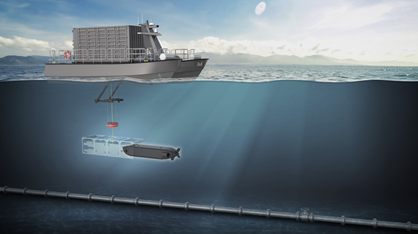
Figure 1: Rendering of the integrated XLUUV + USV + LARS solution
The subsurface platform
The TII-designed XLUUV is a 5.5-meter modular platform engineered for rapid, scalable production. Designed to be transportable within a standard 20-foot container, the vehicle can be launched from slipways, vessels of opportunity, or our purpose-built USV.
We have adopted a "free-flooded" design philosophy that prioritizes modularity.
The vehicle features a mutable middle section that can be quickly reconfigured on-site, supporting diverse mission profiles from ISR, ASW, and hydrographic sensing to the deployment of seabed packages like acoustic recorders.
Modularity of this kind matters more than it may appear. A vehicle configured for a single mission profile commits its operator to that profile for the life of the platform. A reconfigurable payload section allows one hull to serve a mission set that will change faster than the hull can be replaced, and allos production to scale against a common design rather than a family of variants.
With a full battery configuration, the platform is targeted to reach a range of 450km on a single charge.
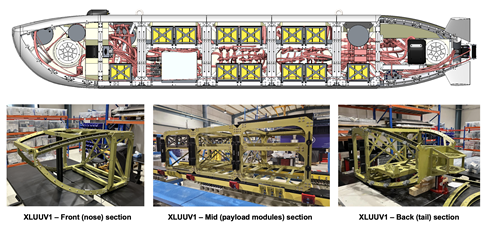
Figure 2: Top: internal view of the vehicle
Bottom: vehicle currently being assembled
The XLUUV is supported by a custom 17-meter aluminum catamaran USV, currently in manufacturing phase. Designed for week-long endurance, this surface platform serves as the communication and charging relay for the XLUUV. Utilizing our LARS, the USV enables the XLUUV to perform autonomous missions, effectively extending operational range indefinitely. The USV is scheduled to begin operations in Abu Dhabi waters in Q1 2027.
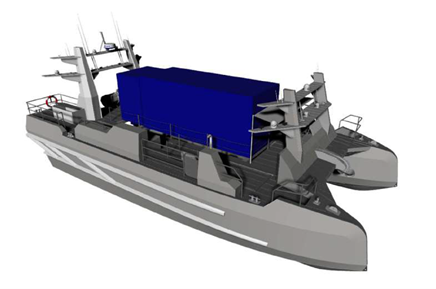
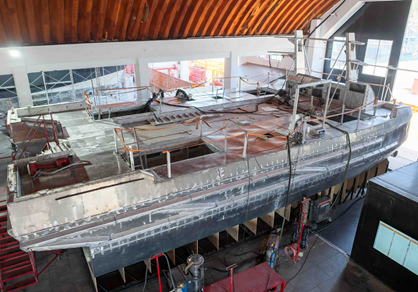
Figure 3: 17-meter aluminum catamaran USV (manufacturing)
We are currently in the final assembly phase of the XLUUV. The platform will be presented publicly for the first time at Euronaval (France) in November 2026, with initial sea trials commencing in December 2026.
We are tracking toward full operational readiness in 2027.
By decoupling marine operations from manned surface vessels, we are establishing a new standard for cost-effective, persistent underwater data acquisition.
The water column is the harder problem
None of the above holds unless the vehicles can be reached while they are working. The difficulty here is environmental rather than an engineering constraint. Radio does not usefully propagate through seawater. Acoustics do, but the channel is narrow, slow and shaped by temperature, salinity, depth and seabed geometry; a link that performs adequately in the morning may have degraded by the afternoon. Optical links carry far more data but only over short ranges, in clear water, and with alignment held between transmitter and reeiver. Magnetic induction is reliable at very close quarters and useless beyond them. Each mode fails where another would have worked, which is why a single-mode modem forces a permanent trade between range and bandwidth, made at the design stage on behalf of every mission the vehicle will ever undertake.
One of the main requirements for underwater operations is to provide our vehicles with communications:
TII ARRC Networked Robotics’ UniSDM (Multimode Software-Defined Modem for Underwater Communications) enables versatile, eco-friendly underwater communications by integrating acoustic, optical, magnetic induction, and RF links within a single flexible platform. Unlike conventional single-mode modems, UniSDM dynamically selects or combines communication modes based on channel conditions, range, and mission requirements, ensuring robust connectivity for AUVs, ROVs, divers, sensor networks, and subsea infrastructure. By consolidating multiple communication technologies into one device, it reduces system cost and complexity, minimizes acoustic interference and sound pollution, and enables advanced multi-mode capabilities such as cooperative Multiple-Input Multiple-Output (MIMO). This provides a resilient and scalable communications backbone supporting defense, maritime security, offshore inspection, infrastructure monitoring, and scientific exploration.
The design principle is that link availability matters more than peak performance in any single mode. A modem that adapts to the channel it actually encounters will outperform one optimized for conditions that may or may not be present.
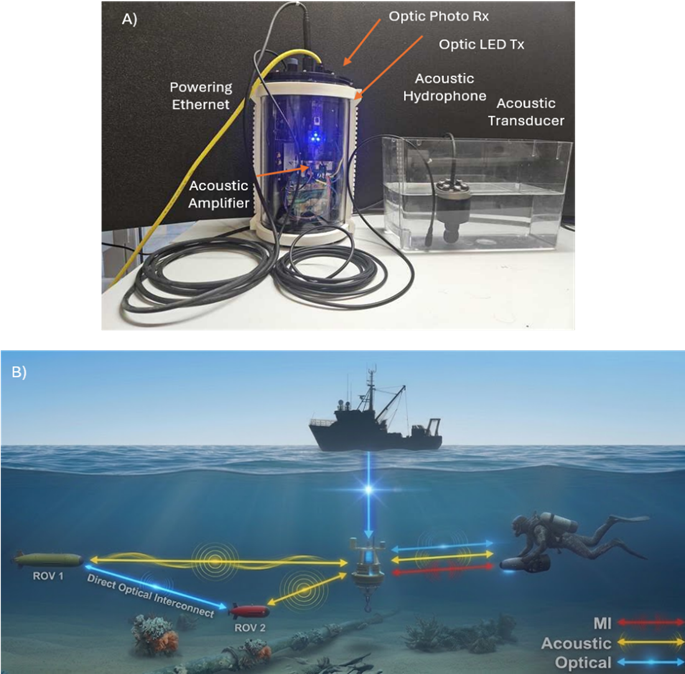
Figure 4 – UniSDM system A) Underwater prototype and B) Multimode Communication Concept
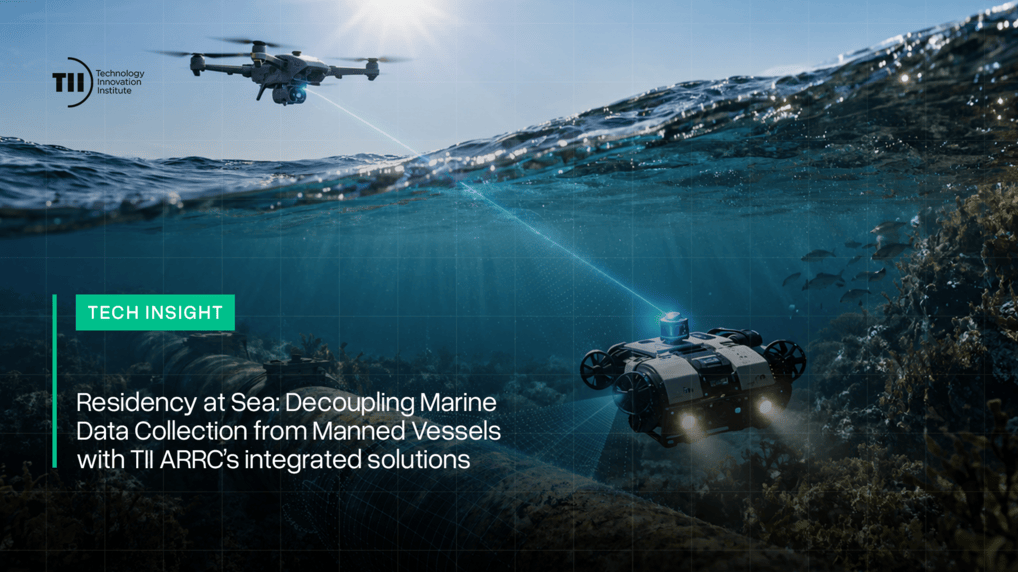
The Water-Air Communications System extends communication capability beyond the underwater domain by enabling direct, high-speed optical links between UAVs and underwater assets across the water–air interface. Through autonomous detection, localization, and alignment, it establishes secure, low-latency, high-bandwidth connections for real-time command, control, and transmission of telemetry, sensor data, imagery, and video. This eliminates dependence on surface relay vessels, significantly reduces response times, and expands operational reach while enhancing persistent situational awareness in complex and contested environments. The system enables tighter coordination between airborne and underwater autonomous platforms, delivering decisive advantages for naval operations, offshore energy inspection, and environmental monitoring.
This is the point at which the surface stops being a required position. An aircraft passing overhead can open a connection, transfer instructions and recover data without anything holding statoin above the asset, removing the last structural reason to keep a crewed vessel on site.
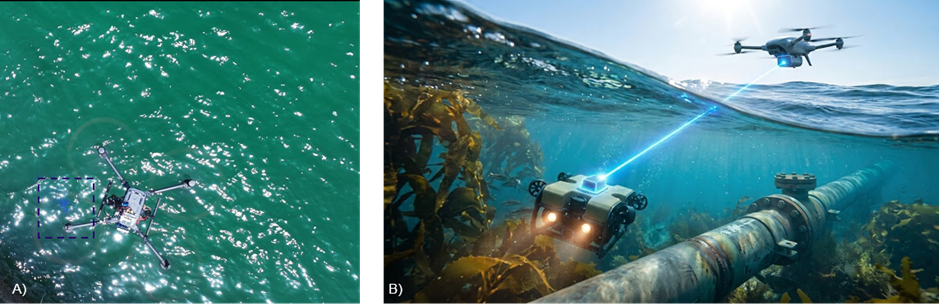
Figure 5 – Water-Air Communication between UAV and Underwater Node A) Validation in field, with UAV-UW node communication at 110kbps, 10m UAV height, and 3m UW node depth and B) Communication System Concept
Together, TII ARRC solutions provide end-to-end maritime capability across the full ocean domain, connecting surface, air, and deep-sea operations seamlessly and autonomously. Use cases include naval operations, offshore inspection, and environmental monitoring. Underwater and Water-Air Communications provide an intuitive solution for UUV control and real-time data collection.
The ambition has always been to make the ocean a place where operators are continuously present rather than periodically visiting. That will not be achieved by building larger vehicles that stay down longer, but when a submerged asset is as reachable as one on the surface, and the ship overhead becomes optional instead of structural.